March is recognized in Canada as Fraud Prevention Month, a national initiative dedicated to raising awareness about fraud and protecting individuals from deceptive practices.
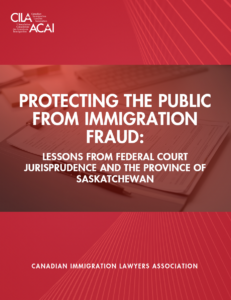
CILA’s new report, Protecting the Public from Immigration Fraud: Lessons from Federal Court Jurisprudence and the Province of Saskatchewan aims to shed light on immigration fraud and contribute to policy discussions aimed at strengthening protections for the public and preserving the integrity of Canada’s immigration system.
This report examines immigration fraud through the lenses of Federal Court jurisprudence and provincial regulatory enforcement, canvasing how immigration fraud is adjudicated at the federal level and how it is regulated and enforced at the provincial level.
- Media are invited to contact CILA at: research@cila.co
The first part analyzes Federal Court decisions from 2025–26 involving allegations of fraud, misrepresentation, “ghost” consultants, and incompetent representation. Drawing on publicly available jurisprudence, the discussion highlights several key trends. First, findings of misrepresentation under section 40 of the Immigration and Refugee Protection Act remain difficult to overcome, even where representative misconduct is involved, reflecting the Court’s consistent emphasis on applicant responsibility for the accuracy of their applications. Second, while allegations of incompetent representation are relatively common, they continue to face a high dismissal rate due to the demanding legal threshold required to establish a miscarriage of justice. Overall, the limited data regarding ghost consultants in published decisions from the Court suggests that matters involving such consultants are more likely than not to be dismissed, keeping in mind that each matter before the Court turns on its own facts.
The second part shifts the focus from adjudication to enforcement by examining Saskatchewan’s consolidated provincial framework under the Immigration Services Act. Saskatchewan’s model is shown to be unusually proactive, with meaningful sanctions imposed against unauthorized consultants, recruiters, and employers. Compared to federal professional regulation alone, provincial enforcement under the Immigration Services Act of Saskatchewan appears to offer a more immediate and tangible deterrent to fraudulent and exploitative conduct. At the same time, the second part of the Report identifies legal and practical constraints, including jurisdictional overlap, resource demands, and the inability of provincial remedies to mitigate federal immigration consequences for victims.
This report highlights that neither federal judicial review nor provincial regulation is sufficient on its own to address immigration fraud comprehensively. However, when viewed together, they reveal the potential for a coordinated, multi-level enforcement approach. Saskatchewan’s experience demonstrates that provincial governments can play a decisive role in protecting newcomers and reinforcing system integrity, while Federal Court jurisprudence underscores the need for clearer pathways to mitigate immigration consequences where fraud is established. The report concludes that greater alignment between provincial enforcement mechanisms and federal immigration decision-making is essential to delivering meaningful justice for individuals harmed by fraud and misrepresentation.
Recommendations
- Strengthen enforcement against unauthorized representatives and ghost consultants.
- Improve transparency and reporting on immigration fraud cases.
- Enhance collaboration between federal and provincial regulators.
- Encourage provinces to adopt stronger enforcement frameworks.
- Increase public education and awareness regarding immigration fraud.
Read More